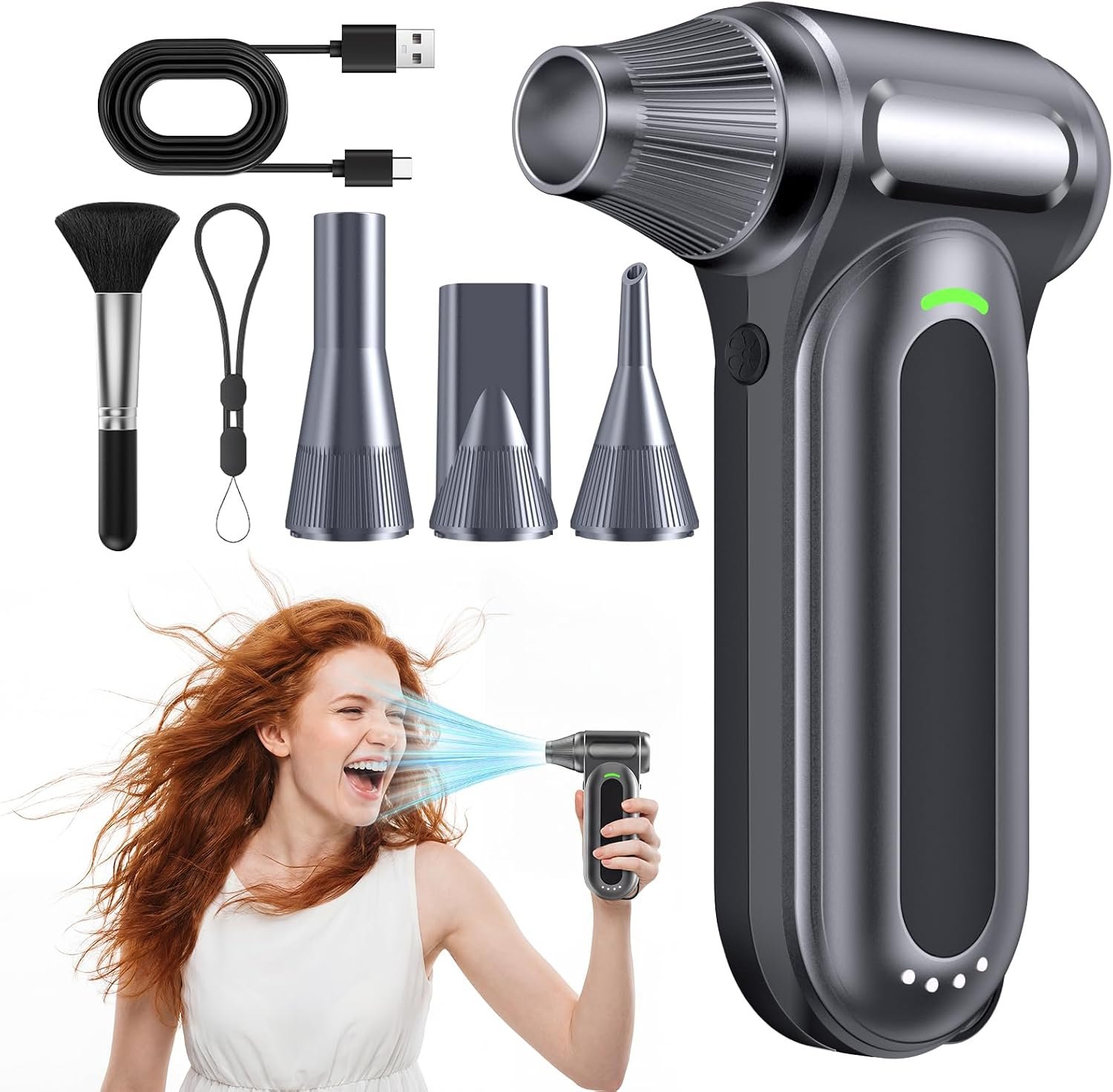
Dust is one of those everyday problems that can be easy to overlook until it starts collecting in places that are difficult to reach. Keyboards develop crumbs and fine particles between the keys, computer cases accumulate dust around vents, car interiors collect debris in narrow gaps, and small electronic devices can become difficult to clean with an ordinary cloth.
A handheld electric air duster offers another approach. Instead of relying on disposable compressed-air cans, an electric blower uses a motor to produce a stream of air that can be directed toward dusty surfaces and hard-to-reach areas. The product discussed in this guide is a Compressed Air Duster with a 170,000 RPM brushless motor, four-speed operation, and a rechargeable cordless design, intended for applications such as keyboards, PCs, cars, electronics, and general cleaning.
The important thing to understand is that the number 170,000 RPM describes the rotational speed of the motor or fan system. It should not automatically be interpreted as a measurement of airflow volume, cleaning performance, or air pressure. In practical use, factors such as the nozzle design, airflow path, speed setting, distance from the surface, and type of debris can all affect the result.
This guide explains how this type of electric air duster works, where it can be useful, what its limitations are, and what to consider before incorporating one into a cleaning routine.
What Is a Handheld Electric Air Duster?
A handheld electric air duster is a compact powered blower designed to direct air toward dust, crumbs, lint, and other loose particles.
Traditional canned air products use a pressurized propellant stored inside a disposable container. An electric air duster takes a different approach: its rechargeable battery powers a motor, which drives a fan or turbine system and produces moving air.
The cordless design can make the tool convenient for situations where an electrical outlet is not nearby. Depending on the model and operating conditions, the battery can be recharged between uses rather than replacing an entire can after the contents are depleted.
This particular product is described as having a 170,000 RPM brushless motor, four speed settings, and a rechargeable cordless configuration. Those characteristics make the device relevant to several types of cleaning tasks, particularly where controlled airflow and portability are useful.
However, an electric air duster is not a universal replacement for every cleaning method. A blower moves loose particles; it does not necessarily collect them. In some situations, vacuuming, wiping, brushing, or a combination of methods may be more appropriate.
Key Features
170,000 RPM Brushless Motor
The product is identified with a 170,000 RPM brushless motor. RPM means revolutions per minute and describes how quickly a rotating component operates.
A high RPM specification can be useful when discussing the design of a compact electric blower, but it is important not to treat RPM as a direct measurement of cleaning power.
Airflow depends on more than rotational speed. The design of the fan or turbine, air intake, nozzle, motor efficiency, and overall airflow system all contribute to how air reaches the target.
For this reason, the most useful way to think about the 170,000 RPM specification is as a motor-performance characteristic rather than a guarantee of a particular cleaning result.
The brushless motor design is also relevant. Brushless motors eliminate the traditional mechanical brushes used in brushed motors and are commonly used in compact electronic devices and power tools. Their design can support efficient operation, although actual performance and operating time depend on the entire device rather than the motor specification alone.
Four-Speed Operation
The inclusion of four speed levels provides more control than a single-speed blower.
Different cleaning situations can call for different airflow levels. A lower setting may be more appropriate when working around delicate or lightweight objects, while a higher setting can be useful for moving more stubborn loose debris.
Having several settings also makes it easier to adapt the tool to different environments.
For example, cleaning a keyboard may require a different approach from clearing leaves or debris from a vehicle’s floor mat. Being able to adjust the airflow can help reduce unnecessary force and make the tool more versatile.
The practical value of multiple speed settings depends on how easily they can be selected and how distinct the settings feel during use.
Cordless Rechargeable Design
A rechargeable battery removes the need for a permanent power cable during cleaning.
This can be especially useful when moving between rooms, working inside a vehicle, cleaning a workshop, or handling equipment away from a desk.
A cordless air duster can also be stored with other cleaning equipment and used when needed without connecting it to an outlet.
Battery-powered operation does introduce another consideration: runtime. The amount of time the device can operate depends on the battery capacity, speed setting, operating conditions, and battery condition.
Higher airflow settings generally require more energy, so users who regularly perform extended cleaning sessions should pay attention to charging requirements and expected operating time.
Compact Handheld Format
The handheld form factor is designed around portability.
Instead of using a large blower or shop vacuum, users can hold the device directly and aim the airflow at a specific area.
This can be helpful when cleaning small spaces such as:
- Keyboard gaps
- Computer ventilation openings
- Desk equipment
- Car air vents
- Camera equipment exteriors
- Gaming accessories
- Shelving corners
- Workshop tools
- Small household devices
A compact tool is also easier to keep in a drawer, cabinet, garage, or equipment bag than a larger cleaning appliance.
Designed as a Canned-Air Alternative
One of the main reasons people consider electric air dusters is to reduce reliance on disposable compressed-air cans.
An electric device does not use a new can for every cleaning session. Instead, it relies on electricity stored in its rechargeable battery.
That can make it a practical option for people who clean frequently.
The two approaches are not identical, however. Canned air and electric blowers differ in airflow characteristics, pressure behavior, handling, maintenance, and operating time. The appropriate choice depends on the task and the user’s cleaning habits.
How It Can Be Used
Cleaning Computer Keyboards
Keyboards are one of the most obvious applications for a handheld air duster.
Dust, hair, crumbs, and other small particles can settle underneath and between keys. A stream of air can help move loose debris out of these spaces.
For routine cleaning, the keyboard should be disconnected or powered down when appropriate. The device can then be positioned so that debris is blown away from the keyboard rather than deeper into another opening.
A moderate airflow setting can be a sensible starting point. Users can increase the airflow if necessary while maintaining an appropriate distance.
Air alone may not remove sticky residue or oily deposits. Those generally require a suitable cleaning method rather than stronger airflow.
Cleaning Desktop Computers
Desktop computer cases often have ventilation openings designed to allow air to move through the system.
Over time, dust can accumulate around these openings, fans, filters, heatsinks, and other accessible areas.
An electric air duster can help dislodge loose dust from the exterior and accessible components.
Before cleaning inside a computer, it is important to shut down the system and disconnect power. Users should also avoid allowing a high-speed airflow stream to spin internal fans excessively if the cleaning method could cause them to rotate rapidly.
The goal is to remove dust rather than mechanically stress components.
A vacuum can then be useful for collecting dust that has settled around the surrounding workspace, while the blower is used to move particles from hard-to-reach areas.
Cleaning Laptop Vents
Laptop ventilation openings can collect dust and lint over time.
A handheld air duster can be used around accessible exterior vents to move loose debris away from the openings.
Because laptops contain compact components and delicate internal structures, users should avoid treating the air duster like a high-pressure industrial tool. Gentle, controlled airflow is generally more appropriate than holding the nozzle extremely close and using maximum power continuously.
The manufacturer’s cleaning guidance for the particular laptop should also take priority.
Cleaning Gaming Equipment
Gaming setups can contain several dust-collecting surfaces, including keyboards, controllers, desktop PCs, monitor stands, consoles, and accessory docks.
A portable air duster can be incorporated into a periodic cleaning routine.
For example, users might first remove loose dust from keyboards and controller surfaces, then clean the surrounding desk area separately.
Airflow can help reach narrow gaps that are difficult to clean with a microfiber cloth.
Cleaning Car Interiors
Vehicle interiors contain many narrow spaces where dust and debris accumulate.
A handheld blower may be useful around:
- Dashboard gaps
- Air vents
- Seat rails
- Center-console openings
- Door pockets
- Cup holders
- Buttons and controls
- Trunk edges
- Floor mat surfaces
The advantage is portability. The device can be used without connecting to a wall outlet.
For larger amounts of dirt, however, an automotive vacuum remains useful because it collects the debris instead of simply moving it around.
One practical approach is to use airflow to loosen debris from difficult areas and then use a vacuum to collect the displaced material.
Cleaning Camera Exteriors and Accessories
Photography equipment can benefit from careful dust management.
An air duster may be useful for cleaning loose particles from the exterior of camera bodies, lens barrels, bags, tripods, and other accessories.
However, camera sensors and optical surfaces require special care. A powerful electric blower should not automatically be treated as appropriate for every camera-cleaning application.
Users should follow the camera or lens manufacturer’s recommended procedure for sensitive optical components.
Cleaning Workshop Tools
Workshops often contain sawdust, metal filings, dirt, and other particles.
An air duster can help clear loose debris from hand tools, work surfaces, equipment exteriors, and other areas.
Extra caution is required when dealing with potentially hazardous particles. Blowing dust into the air can make it easier to inhale or spread contaminants throughout a workspace.
When dealing with fine dust, chemical residues, or potentially harmful materials, appropriate protective equipment and containment methods are more important than simply producing stronger airflow.
Cleaning Small Household Areas
The device can also be useful for ordinary household maintenance.
Examples include:
- Dusting behind appliances
- Cleaning narrow shelves
- Clearing debris from window tracks
- Removing crumbs from drawers
- Cleaning around decorative objects
- Clearing dust from vents
- Cleaning small tools
- Removing loose particles from furniture gaps
The main advantage is the ability to direct airflow into spaces where a cloth cannot easily reach.
Who It May Be Suitable For
Computer Users
People who regularly maintain desktop computers, keyboards, gaming PCs, and accessories may find a rechargeable air duster useful as part of a regular cleaning routine.
It can provide a portable source of airflow without requiring disposable cans.
Gamers
Gaming setups often contain multiple electronic devices and accessories in one area.
A compact blower can be used for routine removal of loose dust from keyboards, controllers, PC exteriors, and desk equipment.
Car Owners
A cordless design can be practical for cleaning inside a vehicle, particularly around vents, controls, storage compartments, and narrow gaps.
It does not replace an automotive vacuum, but it can complement one.
DIY and Workshop Users
People who frequently work with tools may appreciate having a small blower available for removing loose particles from equipment and workspaces.
The suitability depends on the type of material being cleaned and whether blowing dust into the surrounding environment is safe.
Home Office Users
Home offices often contain keyboards, computers, printers, monitors, cables, and other equipment.
A handheld air duster can provide an easy way to incorporate airflow into a periodic cleaning routine.
People Who Clean Frequently
An electric air duster can make more sense for someone who frequently cleans electronics or narrow spaces than for someone who only needs occasional dust removal.
The rechargeable design is particularly relevant when the device will be used repeatedly.
Important Things to Consider
RPM Does Not Equal Airflow
One of the most important technical points is understanding the difference between RPM and airflow.
A motor spinning at 170,000 RPM does not mean the device produces 170,000 units of air movement or that it automatically performs better than every lower-RPM blower.
RPM describes rotational speed.
Airflow is influenced by the complete air-moving system.
When comparing electric air dusters, specifications such as airflow, nozzle design, battery capacity, operating modes, and physical design may provide more useful information about practical operation than RPM alone.
Four Speeds Require Appropriate Adjustment
More airflow is not always better.
A high setting can move lightweight objects, scatter dust across a room, or potentially disturb delicate components.
Starting with a lower setting gives users more opportunity to observe how the material responds.
The appropriate distance also matters. Holding the nozzle extremely close to a surface can create a more concentrated stream than holding it farther away.
Air Dusting Moves Debris
An air duster is fundamentally a particle-moving tool.
It can loosen and relocate dust, but it does not collect the material.
This distinction is important.
If dust is blown from a keyboard onto a desk, the keyboard is cleaner, but the dust still exists.
A useful cleaning process can therefore involve two stages: use controlled airflow to dislodge debris from difficult areas, then use a cloth or vacuum to collect the material from the surrounding surface.
Protect Your Eyes
Airborne dust and small particles can become airborne quickly.
Protective eyewear can be appropriate when using an air duster, especially in workshops, garages, or dusty environments.
Users should also avoid directing airflow toward their face or other people.
Be Careful Around Electronics
Electronics require controlled cleaning.
Before cleaning a computer, keyboard, game console, or other electronic device, power it down as appropriate and follow the manufacturer’s maintenance guidance.
Avoid forcing debris farther into ventilation openings.
It is also important to remember that an air duster is not designed to remove liquids or replace proper electronic cleaning procedures.
Avoid Hazardous Dust
Not every material should be blown into the air.
Fine particles from certain construction materials, chemicals, biological contaminants, or other hazardous substances can create health risks when airborne.
For potentially hazardous dust, appropriate containment, filtration, and protective equipment should be considered instead of simply using a blower.
Battery Management
Because the device is rechargeable, battery management becomes part of ownership.
Users should become familiar with the charging procedure and recommended charging environment.
If the tool is stored for a long period, maintaining the battery according to the manufacturer’s guidance can help preserve its usability.
Noise
High-speed motors and airflow systems can produce noticeable sound.
Noise may be less important for a quick cleaning session but more relevant when using the device frequently or in a shared workspace.
People sensitive to noise may prefer to use it during appropriate times and, where necessary, use hearing protection in louder workshop environments.
Electric Air Duster vs. Canned Compressed Air
Electric air dusters and canned compressed air solve similar problems through different mechanisms.
A canned product stores pressurized material inside a disposable container. An electric duster generates airflow using a motor.
An electric unit may be more convenient for repeated cleaning because it can be recharged rather than replaced after each can is depleted.
Canned air can still be useful when a specific application calls for its particular airflow characteristics or when portability and immediate use are more important than rechargeability.
The decision depends on cleaning frequency, storage preferences, required airflow characteristics, and the type of equipment being cleaned.
Electric Air Duster vs. Vacuum Cleaner
A vacuum and a blower perform complementary jobs.
A vacuum collects dust and debris.
A blower moves it.
For computer maintenance or car cleaning, using both can sometimes be more effective than relying on either one alone.
For example, a blower can loosen dust from a difficult gap while a vacuum positioned nearby collects the displaced material.
A vacuum is generally more appropriate when the primary objective is to remove debris from an area rather than relocate it.
Electric Air Duster vs. Manual Brush
A brush provides direct physical contact with the surface.
It can remove certain types of dirt that airflow cannot, especially when particles are attached to a surface.
However, a brush may be difficult to use in narrow gaps or around delicate structures.
An air duster can reach some of those spaces without direct contact.
In many cleaning routines, the two approaches can complement one another.
Electric Air Duster vs. Microfiber Cloth
Microfiber cloths are useful for surfaces that need wiping rather than simply dust removal.
They can remove fingerprints, oils, smudges, and certain residues that airflow cannot.
An air duster is more useful for loose particles in gaps and openings.
For electronic equipment, a combination of controlled airflow and appropriate surface wiping may provide a more complete routine.
A Practical Electronics Cleaning Routine
A simple cleaning routine can reduce unnecessary dust accumulation without relying on aggressive airflow.
Start by shutting down and disconnecting equipment where appropriate.
Move the equipment to a suitable cleaning area if possible.
Use a low or moderate airflow setting first and direct dust away from sensitive openings rather than deeper into them.
Work gradually rather than holding the airflow in one location for an extended period.
After loosening dust, clean the surrounding workspace using a suitable cloth or vacuum.
Finally, inspect the equipment before reconnecting or powering it on.
The exact procedure should always be adapted to the equipment manufacturer’s maintenance recommendations.
A Practical Car Cleaning Routine
For vehicle cleaning, an electric air duster can be used as one step in a broader process.
Begin by removing larger debris manually.
Use airflow around vents, buttons, seat rails, console gaps, and other difficult areas.
Then use a vacuum to collect loosened debris.
Follow with appropriate interior cleaning products for surfaces that require wiping.
This approach prevents the blower from simply redistributing dust throughout the cabin.
Storage and Maintenance
Keeping a compact electric air duster clean can help maintain its usefulness.
After use, inspect the air intake and exterior for accumulated dust or debris.
Store the device in a dry location and follow the manufacturer’s recommendations for battery charging and storage.
Avoid exposing the tool unnecessarily to moisture unless it is specifically designed for such conditions.
The nozzle and airflow openings should also remain free from obstructions.
Regular inspection is particularly useful when the device is used in garages, workshops, or environments with large amounts of dust.
Frequently Asked Questions
What does 170,000 RPM mean on an air duster?
170,000 RPM refers to the rotational speed of the motor or rotating air-moving component. It is not a direct measurement of airflow volume, pressure, or cleaning performance.
Is an electric air duster the same as canned air?
No. They use different operating principles. An electric duster uses a rechargeable motor-driven airflow system, while canned air uses material stored under pressure in a disposable container.
Can this type of air duster clean a keyboard?
A handheld electric air duster can be used to move loose dust and debris from between keyboard keys. The keyboard should be powered down as appropriate, and airflow should be controlled to avoid simply pushing debris deeper into the device.
Can an electric air duster clean a PC?
It can be used to remove loose dust from accessible areas of a desktop computer. The computer should be shut down and disconnected as appropriate, and users should follow the manufacturer’s cleaning recommendations.
Can it replace a vacuum cleaner?
Not completely. A blower moves debris, while a vacuum collects it. The two tools serve different purposes and can complement one another.
Is the highest speed always the most effective?
Not necessarily. Different surfaces and materials respond differently to airflow. A lower setting may provide better control, particularly around delicate equipment or lightweight debris.
Can it be used inside a car?
A cordless air duster can be useful for cleaning vehicle vents, console gaps, seat rails, dashboards, and other narrow spaces. A vacuum is still useful for collecting the debris afterward.
Can it remove sticky residue?
Airflow is primarily useful for loose particles. Sticky residue generally requires an appropriate surface-cleaning method rather than stronger airflow.
Should the air duster be used around sensitive electronics?
It can be used around some electronic equipment when operated carefully, but users should follow the manufacturer’s cleaning instructions. Sensitive components may require specialized procedures.
Does the rechargeable battery mean unlimited use?
No. The device still has a finite battery capacity and must be recharged. Actual runtime depends on operating conditions and the selected speed.
Can it be used for hazardous dust?
Users should avoid blowing potentially hazardous particles into the air. Fine or contaminated dust may require specialized containment, filtration, and protective equipment.
Does 170,000 RPM guarantee stronger cleaning?
No. Motor speed is only one part of the overall design. Nozzle geometry, airflow system, battery performance, and other engineering factors influence how the tool performs.
Conclusion
A 170,000 RPM handheld electric air duster is designed to provide portable, controlled airflow for a range of cleaning tasks. With a brushless motor, four speed settings, and rechargeable cordless operation, this type of tool can fit naturally into cleaning routines for keyboards, computers, gaming equipment, vehicles, workshop tools, and other areas where loose dust tends to collect.
Its biggest practical distinction from canned air is the rechargeable electric design. Rather than depending on disposable cans, the device generates airflow through its motor system and can be recharged between uses.
At the same time, an air duster should be viewed as one part of a cleaning toolkit rather than a universal solution. It moves loose particles rather than collecting them, and it is not appropriate for every type of dust or every electronic component. Combining controlled airflow with vacuuming, brushing, or surface wiping can often provide a more complete cleaning process.
The four-speed design also makes controlled operation important. A lower setting can be useful when working around delicate or lightweight materials, while stronger airflow may be appropriate for more demanding general cleaning tasks. Understanding the difference between motor RPM and actual airflow is equally important when interpreting the specifications.
For people who regularly clean electronics, keyboards, cars, workspaces, or narrow areas where traditional cleaning tools are inconvenient, a rechargeable electric air duster can be a practical addition to a maintenance routine.
Leave a Reply